Welcome to TrajAtlas’ documentation!#
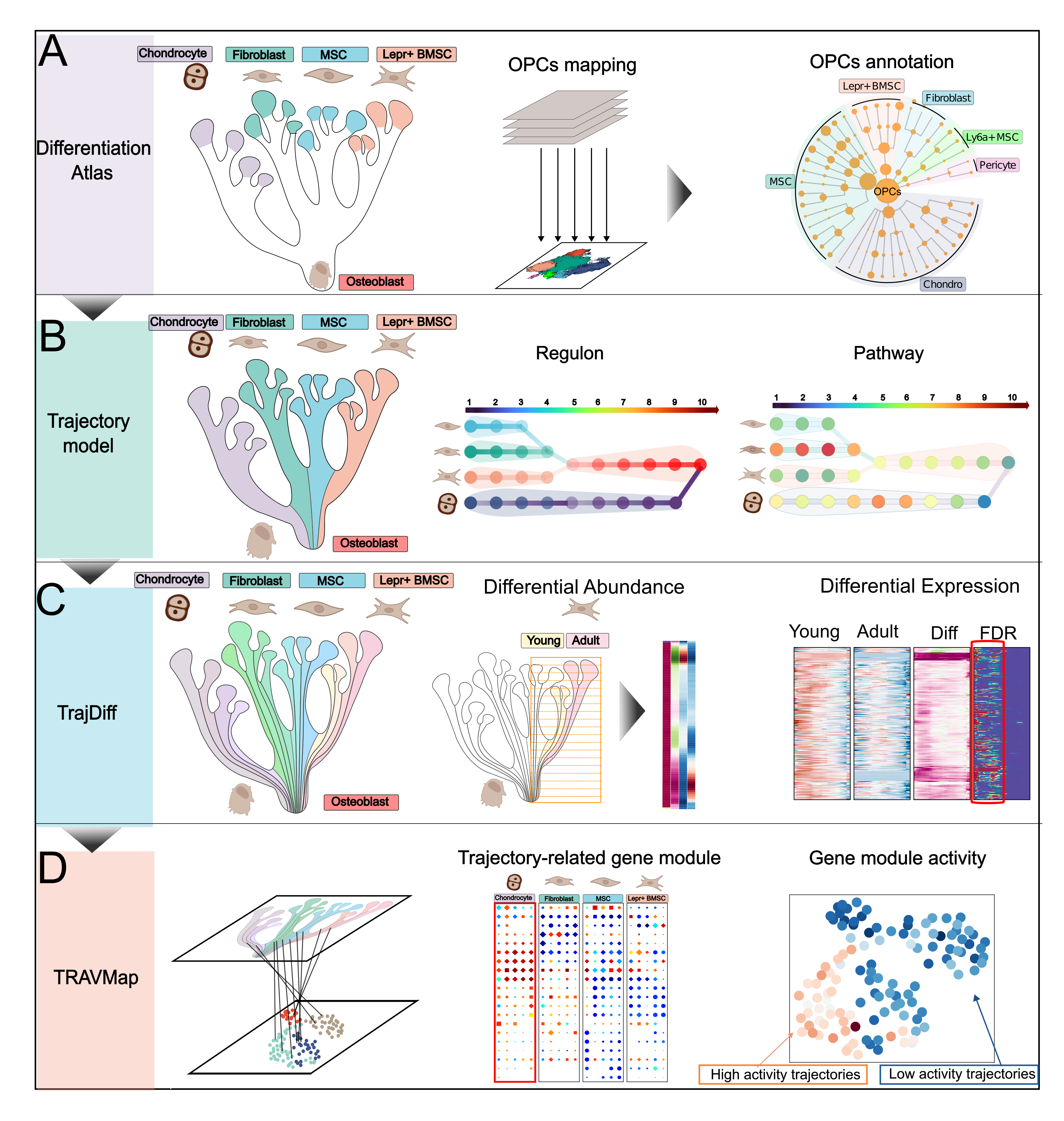
TrajAtlas is a trajectory-centric framework for unnraveling multi-scale differentiation heterogeneity across population-level trajectories. With TrajAtlas, you are able to explore heterogeneity among cells, genes, and gene modules across large-scale trajectories!
The central idea of TrajAtlas revolves around axis-based analysis. Although initially designed for osteogenesis datasets, it can be applied to almost any type of dataset as long as you have an “axis” (such as pseudotime or gene expression patterns).
If you want to do pseudotime analysis, please check
If you are interested in gene expression programs, we have developed a pipeline based on it. Please check
The gene expression program is also a can be applied to spatial omic data. Please check
If you are using gene set scoring for function inference, you can utilize TrajAtlas to identify which genes are more significant within the gene sets.
If you have osteogenesis datasets, you can project your datasets onto our model.
To grasp the foundational concepts of TrajAtlas, please refer to the detailed information provided in About TrajAtlas.
Note
This project is under active development.
TrajAtlas’ Key Applications#
Differential pseudotime analysis, including:
Detecting pseudotemporal gene module
Projecting osteogenesis datasets to Differential Atlas and OPCST model, including:
Beyond Trajectory, including:
… and much more, check out our API
Getting Started with TrajAtlas#
We have Tutorials to help you getting started. To see TrajAtlas in action, please explore our manuscript .
Contributing#
We actively encourage any contribution! To get started, please check out the Contributing Guide.